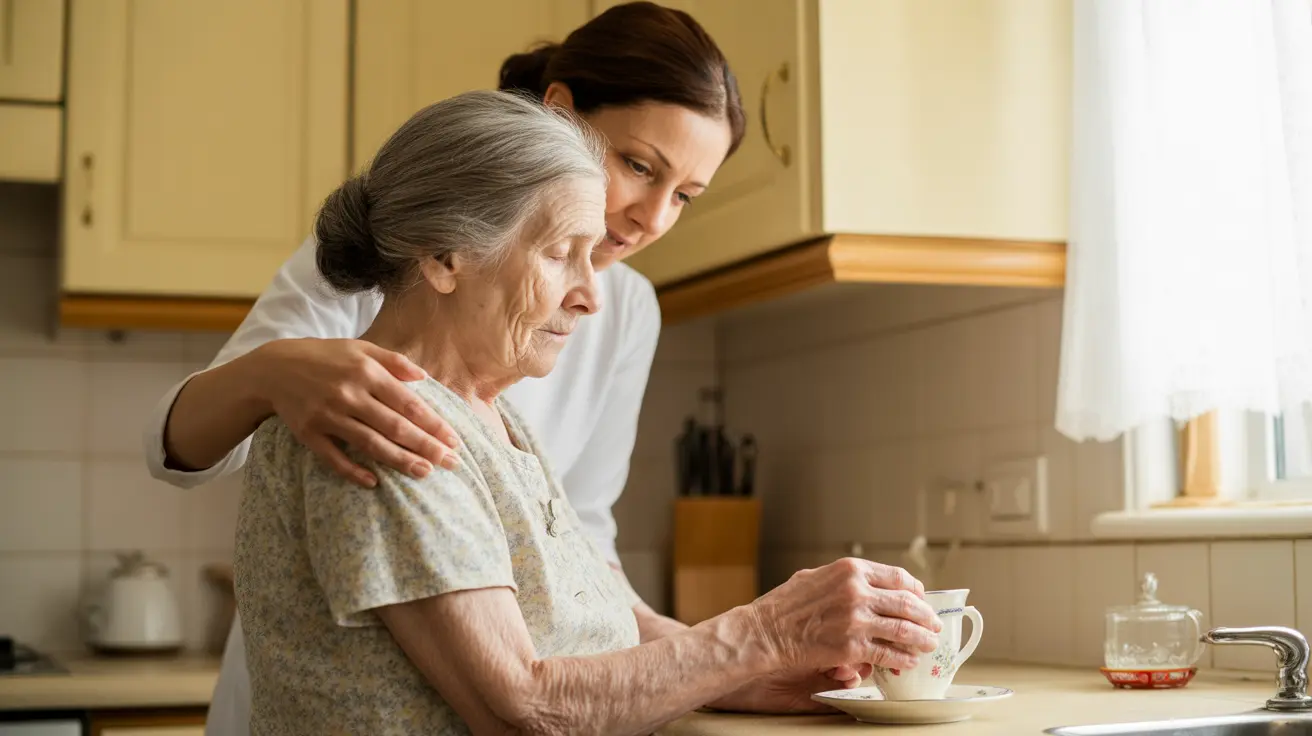
What Does 'Dementia Specialist' Mean?
Every Care Home Claims to Be a Dementia Specialist. Here's How to Tell If One Actually Is.
You'll see it on almost every care home website you visit: "dementia specialist care," "specialist dementia unit," "our team are dementia specialists."
It's one of the most common phrases in the sector, and one of the least regulated. There is no legal definition of what it means for a care home to be a dementia specialist, no qualification it must hold, no standard it must meet before it can use the phrase.
Which means the words alone tell you almost nothing. Yet when it comes to care, and cmfort, meaning matters.
What 'Dementia Specialist' Should Mean — and Usually Doesn't
Genuine dementia specialism is not a job title, a training certificate on the wall, or a dedicated unit with a locked door.
It is a set of practices, attitudes and environmental conditions that reflect a deep, specific understanding of how dementia affects a person's daily experience: their perception, their memory, their ability to communicate, their relationship with routine, their responses to noise and unfamiliarity and change.
A home that genuinely specialises in dementia care has built its entire approach around those realities.
A home that uses the phrase as a marketing descriptor has typically done something much more modest: sent staff on a one-day awareness course, designated some beds as "dementia beds," and added the phrase to its brochure.
The gap between those two things is enormous. And for your mum or dad, it is the difference between a place where they are understood and a place where they are managed.
The Questions That Separate a Genuine Dementia Specialist From a Marketing Badge
Staff training: ask for specifics, not assurances
Every home will tell you their staff are trained in dementia care.
The question is what that training actually consists of. A one-day awareness session and a City & Guilds dementia qualification are not the same thing. A care assistant who has completed the Care Certificate and a Senior Carer who holds a Level 3 Diploma with a dementia pathway are not the same thing.
Ask: what dementia-specific training have your care staff completed, at what level, and how recently?
Ask how many staff hold a formal dementia qualification, not just an awareness certificate. Ask whether the home has a Dementia Champion, a designated staff member with advanced training who leads practice and supports colleagues. A home that genuinely specialises will answer these questions with specifics. A home that doesn't will give you warmth and reassurance and very few numbers.
The physical environment: designed for dementia or adapted for it?
Dementia affects perception, spatial awareness and the ability to interpret unfamiliar environments. A home designed for people with dementia looks and feels different from a standard care home with a locked wing. It has clear, consistent wayfinding — visual cues that help residents navigate independently rather than relying on staff to escort them everywhere. It has calm, low-stimulus communal spaces that reduce sensory overload. It has contrast between floors and walls so that thresholds and furniture are legible to someone whose depth perception has changed. It has access to a safe, enclosed outdoor space, because the evidence that outdoor access improves mood and reduces agitation in dementia residents is consistent and compelling.
Ask to be shown around without a guided narrative. Walk the corridors yourself and ask: could someone with moderate dementia find their own bedroom from the dining room? Could they find the toilet? Is the lighting even and adequate, or are there dark corners and flickering strips? Is the outdoor space genuinely accessible and used, or is it visible through a locked door?
Staffing ratios and consistency: the numbers that actually matter
Staff warmth is the single most cited factor in positive care home reviews, more than food, more than activities, more than clinical quality. But warmth requires time, and time requires staffing ratios that allow it. A home where each carer is responsible for eight or ten residents during a morning routine cannot deliver the patient, unhurried support that dementia care requires at its most demanding moments.
Equally important is staff consistency. People with dementia rely on familiar faces more than almost any other group of residents, because the cognitive work of processing an unfamiliar person is exhausting and distressing. A home with high staff turnover, new agency workers covering shifts, a rotating roster with little continuity, is actively harmful to residents with dementia, regardless of how well-intentioned individual carers are.
Ask: what is your carer-to-resident ratio during morning and evening routines? What proportion of shifts are covered by permanent staff rather than agency? What is your staff turnover rate in the last twelve months?
These are specific, answerable questions. A home with genuine dementia specialism will not be embarrassed by them.
Activities and engagement: personalised or programmatic?
A whiteboard in the corridor listing "10am: Chair Exercise, 2pm: Bingo" is not evidence of dementia-specialist activities provision. It is evidence of a programme. What distinguishes a genuinely specialist approach is personalisation: activities and daily engagement built around who each resident is, what they have always enjoyed, what still reaches them.
The evidence base for dementia care is clear that meaningful engagement, not just stimulation, but activity connected to a person's history and identity, reduces distress, maintains function longer and improves quality of life. A specialist home knows this and operationalises it. It has an activities coordinator who knows each resident's biography. It has a key worker system that connects individual carers to individual residents over time. It does not run the same afternoon programme for every person on the unit regardless of their cognitive stage or personal history.
Ask: how do you find out about a new resident's life history? How does that information shape their daily care? Can you give me an example of an activity that was designed specifically for one resident?
How the home talks about dementia
This one is harder to quantify but easy to observe. Listen to the language staff use when they talk about residents. Do they refer to residents by name, or as "the dementia patients"? Do they describe challenging behaviour as a communication, an expression of unmet need, or as a management problem? Do they talk about the person's history, their preferences, their good days, the things that still make them laugh? Or do they talk primarily about symptoms, medication and containment?
A home where staff genuinely understand dementia talks about it differently. The language reflects a model of care that starts with the person, not the condition. That shift in language is not cosmetic. It reflects a fundamentally different understanding of what the work is.
Ask the manager one question before you leave: "What does a good day look like for a resident with advanced dementia in your care?" The answer will tell you almost everything.
What Genuine Dementia Specialism Looks Like in Practice
A home that genuinely specialises in dementia care does not look dramatically different from the outside. It may not have the newest building or the most impressive reception.
What it has is a quality of attention: carers who move at the pace of the person they are with, not the pace of the next task. Environments that feel calm and navigable rather than institutional. Mealtimes that are unhurried and supported rather than efficient and cleared. An activities programme that you could not run at a different home with a different group of residents, because it was built for these specific people.
It also has something that no inspection report fully captures: a culture.
The way staff speak to each other, the way they speak about residents when relatives aren't in the room, the way a manager responds when something goes wrong. Culture is the hardest thing to assess in a single visit and the most important thing to get right. The questions above are one way in. The other is time: visiting more than once, at different times of day, and trusting what you observe rather than what you are told.
The phrase 'dementia specialist' should mean something. With the right questions, you can find out if it does.
You've noticed something different.
Twelve signs to observe before your next GP appointment. You don't need to wait for a diagnosis to start.
Free download – Dementia Stage 1
Not sure if it's dementia or just ageing? Here's the checklist your GP will use.
Twelve signs to observe. A simple scoring framework. A printable, one-page record you can take to your next GP appointment, so you go in with specifics, not anxiety.
Download Your Checklist