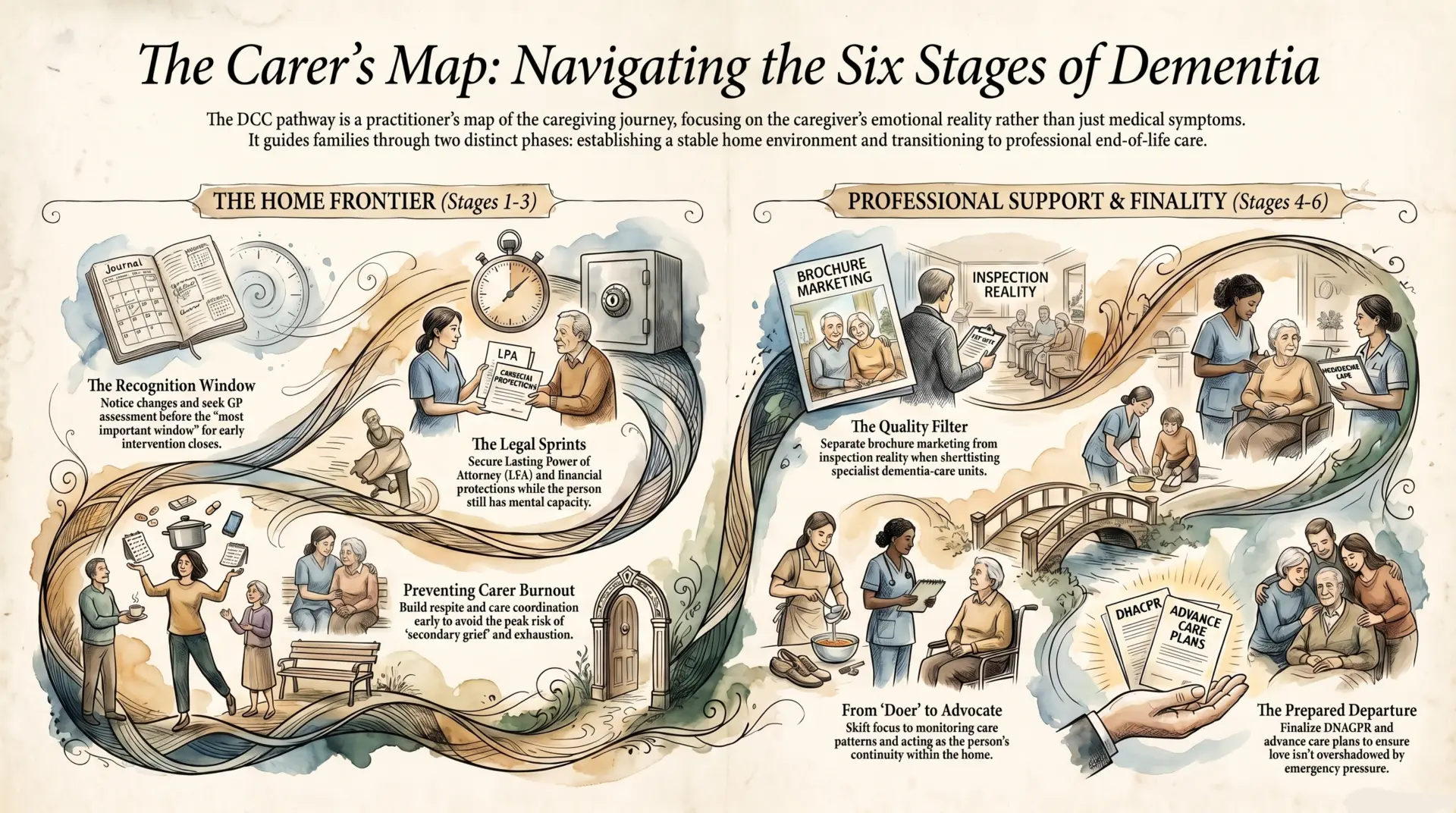
12,000+
families guided through
the dementia care journey

Your parent has dementia. Here's what to do next.
A structured pathway through one of the hardest things you will ever manage.
The right checklist, the right guidance, the right questions – matched to where you are right now.
Find my stage →Browse care homes by postcode ↓

"I was paralysed for weeks not knowing what to do. The stage finder showed me exactly where we were and what came next. It was the first time I'd felt in control since the diagnosis."
"The care home scores gave me something concrete to show my brother when we disagreed. It ended a three-week family argument in one conversation."
"A rating won't tell you she's happy — that line stopped me cold. It's exactly what I was afraid of. The way this site digs into the actual reports is unlike anything else I found."
Your pathway
Every family's situation is different — but the stages are universal. Find yours to get the exact next steps, checklists, and care home guidance that matters right now.
Stage 01
You've had a diagnosis or serious concern. You need to understand what dementia actually means for your family.
I'm at this stage →Stage 02
Home care is working for now, but you're starting to wonder how long that can last and what support exists.
I'm at this stage →Stage 03
Care needs are growing. You're exhausted and starting to think about what a care home would actually mean.
I'm at this stage →Stage 04
You're actively researching. A rating won't tell you she's happy — you need a proper, independent assessment.
I'm at this stage →Stage 05
The move happened. Now you need to know what to watch for, what to ask, and how to stay in control of her care.
I'm at this stage →Stage 06
Long-term care is established. Focus shifts to quality of life, advocacy, and preparing for what comes next.
I'm at this stage →From the first signs of Dementia to finding the right care home, we help you stay informed and organised

Stage 4
Enter your postcode →
Researching, visiting, and comparing care homes. Our directory covers the most highly rated care homes.
A rating won't tell you she's happy.Stage 5
Our Methodology
A CQC "Good" rating can hide serious concerns buried on page 18. We read every report in full and flag what regulators understate.
We take no referral fees, no advertising from care homes, and no commissions. Our assessments are funded by readers, not providers.
Our annual award goes to the homes that genuinely excel across all 9 dimensions of our scoring model. It cannot be bought or applied for.
Tools for your journey
Stage-specific checklists built from real family reviews and professional guidance. Printable. Updated monthly.
Get your checklistA private, structured care journal with AI pattern analysis — so you arrive at every care home meeting knowing exactly what to raise.
Start your journalFind Them Again — a plain-English handbook for families navigating dementia care. Written for real people, not professionals.
About the bookCare Home Directory
We've assessed 3,602 care homes across the UK. Search by postcode to see independent scores, full report analysis, and Robin's Pick awards near you.
Most directories show you a list.
We show you what we found.
Most care home directories show you a name and an address.
We read the CQC inspection report in full before any home appears here. We went through the reviews left by adult children over the past three years, looking at the specific things people mentioned: staffing levels, how concerns were handled, whether the dementia care was genuinely specialist or just a label on a brochure. We checked what each home says about itself on its own website, then checked that against what regulators actually found. Then we built a rating from all of it, weighted around the things adult children told us matter most when they are making this decision.
Every inspection. Every flag.
We read the full report, not just the headline rating. Requires Improvement in one domain matters. We surface it.
What adult children actually said.
We read the reviews, each one, not the average score. Staff consistency, activity provision, how concerns were handled.
We checked what they say about themselves.
Then compared it to what the CQC found. The gap between the two is often the most useful thing we can show you.
One score. Multiple sources.
Staffing, safety, dementia specialism, activity provision, responsiveness. Weighted by what adult children tell us matters most.
Find top-rated homes near you
Enter any UK postcode to see assessed and rated homes in that area.
What this means for you
You are not browsing a list of homes that paid to be listed. You are reading an independent assessment of each one, what was found, what stands out, and what question to ask before you book a visit.
The dementia care guide that should have existed years ago.
The six-stage structure — vital
Dementia care is often a fifteen-year process. Every stage has different priorities, different decisions, and different things that cannot wait. Most adult children spend months managing the wrong things because nobody told them which stage they were at.
Most adult children tell us they wished they had started here. The ones who did saved months.
Select your stage now
Fast action checklists — unusual
Every stage comes with a fast-action checklist built from experience across 3,602 care homes. Not editorial opinion. Not government guidance. What families who have been at your stage actually did, and what they wished they had done sooner.
The families who used these checklists stopped guessing. That is what they told us afterwards.
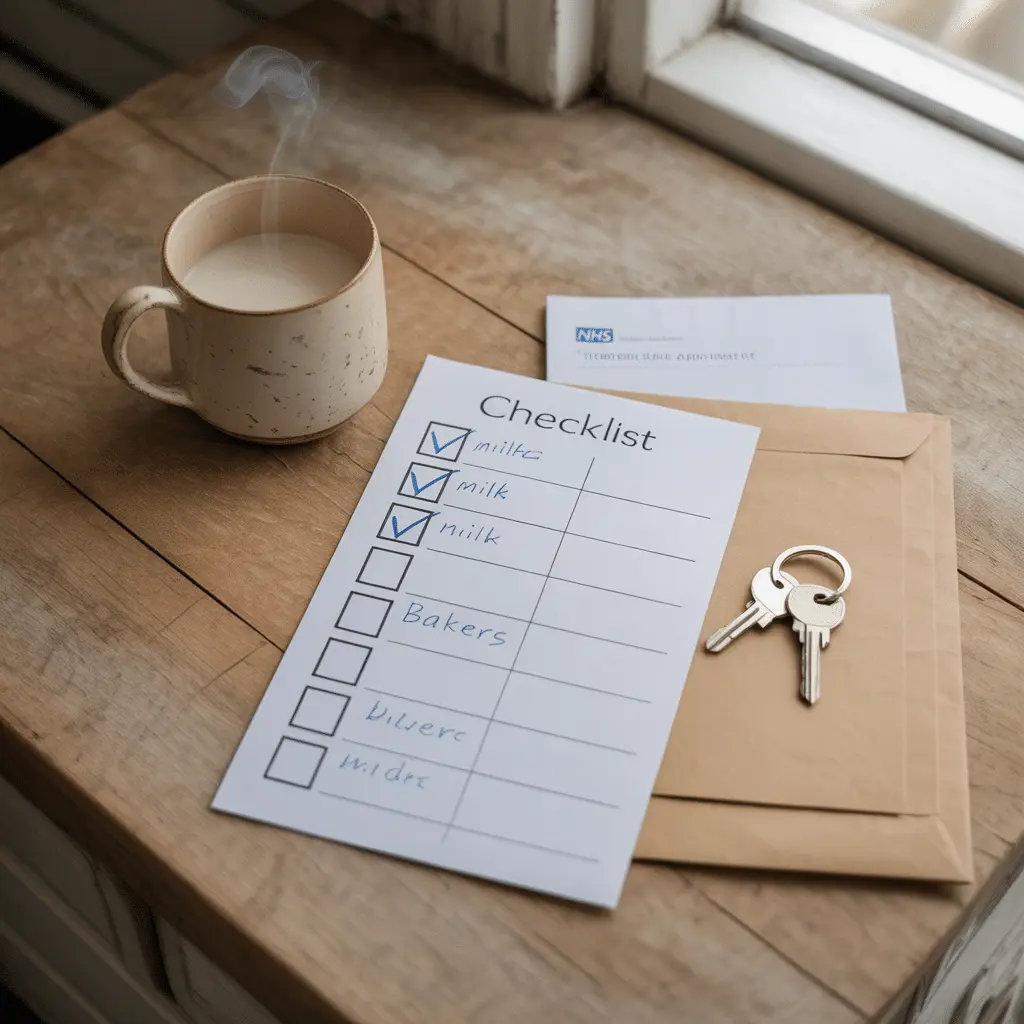
The record nobody else keeps – exclusive
Your GP has clinical notes. The care home has its own logs. You have a worry. None of these talks to each other, and none of them holds what you actually know: what changed last Tuesday, what was said in March, what was promised in January.
There is no other product in dementia care that does this. That is not marketing. It is simply true.

Robin's Pick • 2026 Dementia Awards
Dementia Care: Finding Them Again
A song comes on. A photograph appears. The cat settles onto the sofa. And the person you thought you'd lost looks at you with recognition, real recognition, for the first time in weeks. You didn't imagine it. It happened. And it can happen again.
This book exists because of that moment.
They're still in there, behind the wall.
A song, a scent, a touch, that's all.
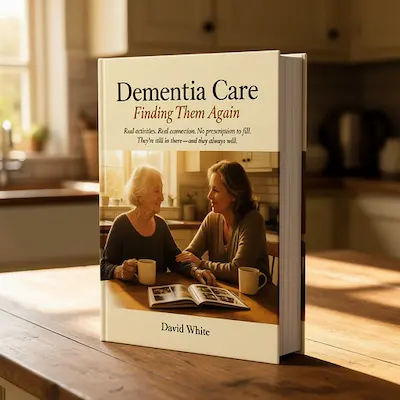
Music. Photographs. Routine. Nature. Movement. Making things. Words. Animals. Stillness. Community. Technology. And a final chapter about you, because you matter in this, too. Each activity is evidence-based, explained by stage, and uses items you already have at home.
The filing cabinets are intact. The records are all there. You just need the right key.
You pushed for the GP appointment. You're the one everyone looks to for answers. This book doesn't talk down to you or wrap hard truths in cotton wool. It tells you what the science says, what other families have found, and what you can do today, whether you're caring at home or visiting a care home.
The manual nobody gave you. Until now.
The things that make the greatest difference to someone living with dementia are rarely the most obvious ones. They are the things that ease the day, that give a carer a moment to breathe, or give the person they care for a moment of calm or quiet joy. Every item here was chosen because it works and because it reduces stress for everyone in the room.